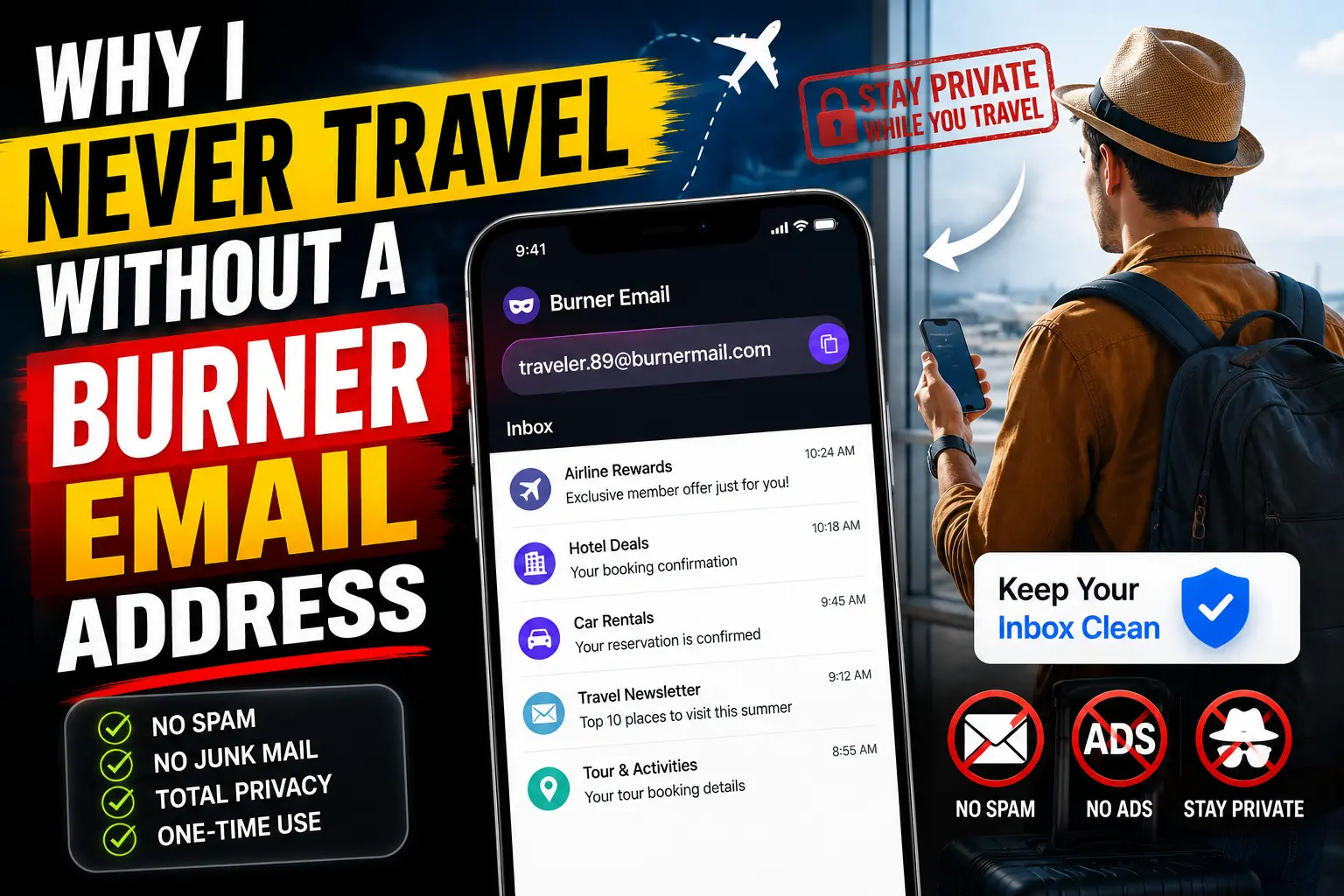
The first time I worked remotely from a café in a foreign city, I made a rookie mistake. I needed to connect to the café’s Wi-Fi. The portal asked for my email address. I typed in my real one without thinking, hit submit, and connected.
By the time I reached my next destination three days later, I had eleven marketing emails from that café chain, a “partner offer” from a local tourism app, and a newsletter from a hotel I’d never stayed at.
I hadn’t given my email to any of those places. But that one Wi-Fi login form had.
That’s when I started keeping a disposable email address open on my phone at all times — like a spare battery or a backup SIM. It’s now as automatic as packing my laptop charger.
The Digital Nomad Email Problem Nobody Talks About
If you work and travel at the same time, your email address is in constant demand. Every new coworking space wants it. Every free tool trial needs it. Every local service app, conference Wi-Fi, hotel loyalty program, and tourist discount card asks for it.
You can’t say no — because half of these are legitimate things you actually need access to. But handing over your real Gmail or work email to every random system means your inbox eventually becomes unmanageable.
For a digital nomad, a chaotic inbox isn’t just annoying. It’s a productivity killer. When you’re working across time zones and juggling clients, the last thing you need is to dig through fifty spam emails to find one important client message.
Related Articles:
- What Is a Disposable Temporary Email? (And When You Actually Need One)
- I Stopped Giving Real Websites My Real Email. Here’s What I Use Instead.
What a Disposable Email Actually Does for You on the Road
A temporary email address is a real, working inbox that isn’t connected to your identity. You open a service like Temp Mail, Guerrilla Mail, or 10 Minute Mail, an address is instantly generated, and you use it for whatever you need.
The email works. Confirmation messages arrive. Verification links click through. But when that coworking space or tourism app starts sending you weekly deals, they’re talking to an inbox that no longer exists — and your real email stays clean.
For nomads specifically, here’s where it genuinely earns its keep:
Coworking day passes. Most require an email for a day pass or guest Wi-Fi access. You’ll never be back. Temp email.
Conference and event registrations. Attending a one-off local event or meetup? They’ll add you to their mailing list forever. Temp email.
Trying local apps. Every city has its own food delivery, ride-hailing, or accommodation app. You’ll use it once and leave. Temp email.
Free trials of tools you’re testing. As a remote worker, you’re always evaluating new software. Sign up with a temp address until you’re sure you actually want their newsletter.
Short-term accommodation platforms. Some regional booking sites (not Airbnb or Booking.com, but smaller local ones) have aggressive email marketing. Temp email for the booking, then screenshot your confirmation.
The Setup That Works for Me
I keep three email addresses in rotation while traveling:
- Real work email — for clients, invoices, anything that matters
- Personal Gmail — for services I actually want updates from
- Rotating temp address — for everything else
I have a browser bookmark to Temp Mail on both my laptop and phone. When any form asks for an email, I take two seconds to think: will I actually want to hear from these people again? If the answer isn’t a clear yes, I open the bookmark, copy the temp address, done.
It sounds like extra friction. In practice it takes under ten seconds, and it’s saved me from hundreds of hours of inbox management over two years.
A Mistake That Cost Me Access to Something I Needed
Here’s the thing nobody tells you: temp emails can backfire if you use them carelessly.
I once signed up for a coworking space’s monthly membership using a disposable address because I was just “testing it for a week.” That week turned into a month. By the time I wanted to log back into their member portal — reset my password, access my billing history — the temp address was long gone.
No password reset possible. No account recovery. Had to create a completely new account and contact them manually to transfer my membership history.
The rule I use now: anything you might need again later, use your real email or a forwarding alias. Services like SimpleLogin or Apple’s Hide My Email are perfect for this middle ground — they forward to your real inbox but hide your actual address. You can turn them off if the spam gets bad, but you keep long-term access to the account.
For Developers and Testers Who Travel
If you’re a remote developer or QA tester, you’re probably already using temp emails for sandbox environments. But there’s a specific use case worth calling out: testing your own deployed apps from different locations.
When you’re traveling and want to verify that your app’s email flows work correctly from a new IP or different region, a disposable inbox like Mailinator lets you do it instantly without creating test users in your database. Just send to any @mailinator.com address and check the public inbox. It’s right there, no login required.
Tools Worth Bookmarking Before Your Next Trip
- Temp Mail (temp-mail.org) — best all-around, auto-generates address, clean mobile UI
- Guerrilla Mail (guerrillamail.com) — good for when you need to choose your own username
- 10 Minute Mail — when you need something that self-destructs fast
- SimpleLogin (simplelogin.io) — best for aliases that forward to your real inbox; Proton-owned, open source, trustworthy
- Apple Hide My Email — if you’re in the Apple ecosystem, this is built in and excellent
What Experienced Nomads Do Differently
After talking to a lot of long-term travelers and remote workers, the pattern I notice is this: beginners try to manage their spam after it arrives. Experienced nomads stop it before it starts.
A disposable email isn’t about being paranoid or distrustful of every website. It’s just inbox hygiene — the same way you wouldn’t give your phone number to every business card you pick up at a conference.
Your real email address is a professional asset. On the road, it’s also your lifeline to clients, contractors, and anyone who matters. Protecting it from the noise isn’t paranoia. It’s just good practice.
The two-second habit of reaching for a temp address instead of your real one is one of those small things that compounds quietly over months of travel. Your inbox stays usable. Your focus stays intact. And you stop dreading the open-laptop moment where you realize you’ve got 300 unread emails — most of which arrived because you once downloaded a free city guide in Lisbon.